



Key takeaways
Shopping tools tend to stop at checkout. The most expensive mistakes happen after it — which is exactly the half nobody tracks.
- Shopping is a loop, not a funnel — Save → Track → Buy → Evaluate → Return → Refund → Repeat — and most tools quit halfway through it.
- Store wishlists exist to keep you inside one retailer, not to compare prices or follow a purchase into its return window.
- An unclosed loop has a real price tag: missed returns alone run roughly $150-225/year on 50 typical purchases, before counting shorted refunds or drops you never caught.
Open a price tracker after you’ve actually bought the thing it was tracking, and watch what happens: nothing. The tracking stops. The wishlist becomes a fossil. You bought it — congratulations, you’re on your own now.
That’s the blind spot in almost every shopping tool. The most expensive mistakes rarely happen at checkout. They happen after: a return window that closes while you’re “still deciding,” a refund that quietly never lands, an exchange you meant to make and didn’t.
Shopping isn’t a funnel that ends at “Buy.” It’s a loop — Save → Track → Buy → Evaluate → Return (if needed) → Refund → Repeat — and almost nothing is built for the second half of it. Every app you’ve used treats “customer” as a different department from “shopper,” with different software and no memory of what you were doing a minute earlier.
Five stages, one loop
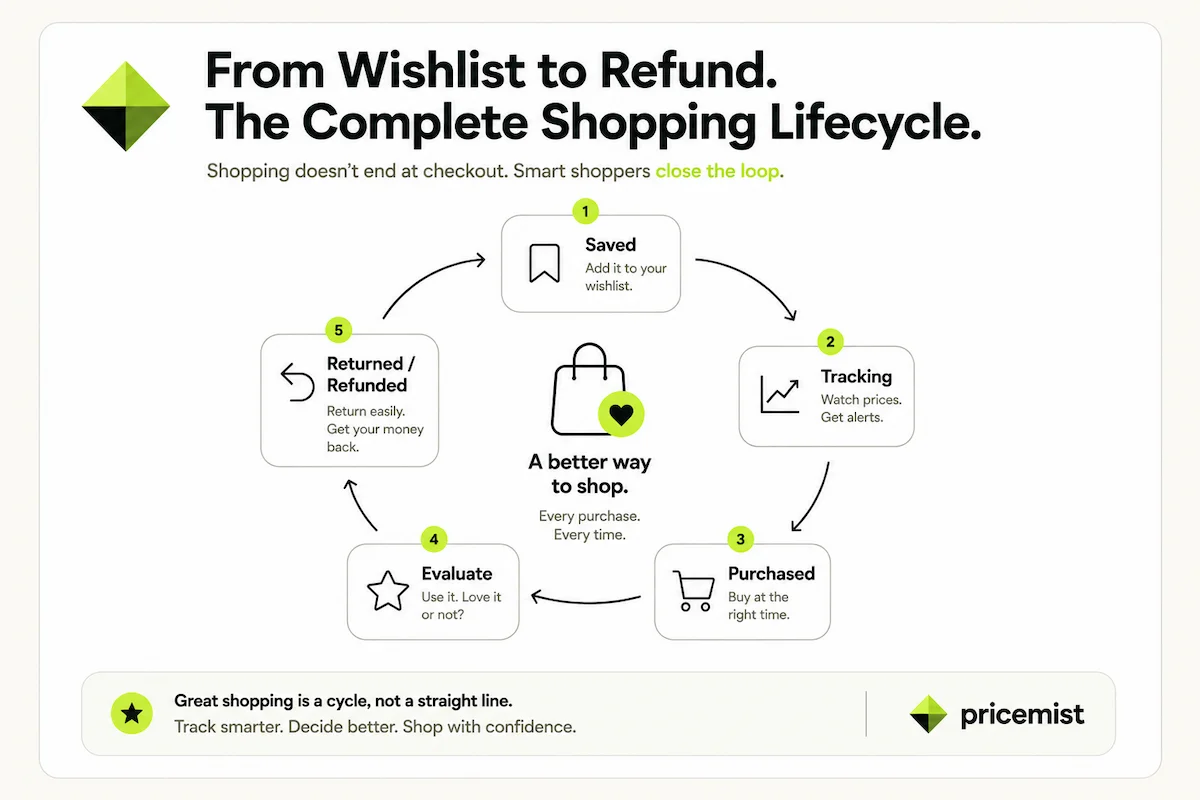
Five stages, one loop. The moment “Returned / Refunded” feeds back into “Saved,” you’re already watching the next thing.
Every stage is a place things quietly go wrong — and every failure is small enough on its own to shrug off, which is exactly why the whole chain rarely gets fixed.
| Stage | Where it usually breaks | What actually works |
|---|---|---|
| Saved | Lost in a tab, a screenshot, a bookmark you’ll never revisit | One-click save, price recorded automatically |
| Tracking | You forget to check, or the only “alert” you get is a marketing email | Daily monitoring and real history, not vibes |
| Purchased | The item vanishes from view — no record of price paid or deadline | Price paid logged, return-window clock starts on its own |
| Evaluate | ”I’ll decide later” quietly becomes “the window just closed” | Days-left visible, a clear “returning” status before it’s too late |
| Returned / Refunded | You ship it back and never confirm the money actually landed | Status tracked until the refund actually hits your account |
Miss any single link and the chain stops paying for itself — a perfectly tracked price you never got to use, or a returned item whose refund you never chased down.
Store wishlists don’t cover any of this
Every store has a wishlist. None of them are built for you.
They exist to keep you inside one retailer’s ecosystem: engaged, logged in, one click from checkout. They don’t compare prices across stores, they don’t track history, and the moment you actually buy something, it quietly moves to “order history” — a separate system, disconnected from everything you were watching a moment earlier.
Say you’re waiting on a jacket at $180 (it was $140 last month), researching a pair of headphones that just dropped 15%, and holding a return label for a kitchen gadget that didn’t work out. Three different states, three different pieces of information worth tracking — and a store wishlist only ever shows you one of them, for one store, and only up until the moment you check out.
You need something that follows you, not the store you happened to buy from.
What an open loop actually costs
The average online return rate sits close to 1 in 5 — NRF and Happy Returns’ 2025 report puts online returns at 19.3%. And a lot of those intended returns never actually happen at all: in a survey of 300+ online shoppers by Loop Returns, almost 9 in 10 admitted they’d kept something they’d actually meant to send back. The item just sits in a closet, the deadline passes, the money’s gone.
Run the numbers on 50 purchases a year at $75 each: about 9-10 are realistic return candidates at that rate. Miss even two or three of those purely because nobody was tracking a deadline — easy to do, given how common that admission above is — and that’s roughly $150-225 a year, and it only counts the returns — not the refunds that landed short and went unnoticed, not the price drop that showed up the week after you bought.
(NRF’s 19.3% is the sourced rate (~9–10 candidates from 50 purchases); the $150–225 total is an illustrative model — miss 2–3 of those at $75 each — not a measured household average.)
Higher-ticket items make the leak bigger, not smaller. One missed $300 jacket return. One forgotten $150 gadget. Neither takes more than a moment of “I’ll deal with it later” to become permanent.
There’s a mental cost too, and it’s not a metaphor. An unfinished return is an open loop, and brains don’t let open loops sit quietly — they keep a low hum of attention on anything unresolved, the same reason a half-answered email nags at you harder than one you never opened at all. Confirm the refund, decide to keep it, ship it back — any of those closes the loop. Only “I’ll deal with it later” keeps it open indefinitely, which is exactly the setting most people leave it in.
Close the loop
The best price in the world means nothing if you miss the return window on something that didn’t work out. Managing the whole cycle, not just the buying half, is the difference between shopping controlling you and the other way around.
It also compounds in your favor over time. Once you can see your purchase and return history in one place, patterns show up on their own — “I’ve sent back four out of five things from this brand” isn’t a feeling anymore, it’s just a fact you can act on. That’s a better filter than any review site.
Not sure a “sale” price is even worth tracking toward? Start with Price History Charts Explained. Already bought something you might send back? The Hidden Cost of Missed Return Deadlines covers the part most people skip.