



Key takeaways
An open tab isn't just clutter — it's an unfinished decision your brain keeps tabs on, and that background hum has a real price.
- Every open tab is an unfinished decision. Brains hang onto unresolved loops harder than closed ones, which is why a half-considered product nags at you like an unanswered email.
- That mental tax produces real financial damage: impulse buys to quiet the noise, first-option purchases, comparison shopping skipped because it feels exhausting.
- A rough model — 10 lingering products, 30 purchases a year, a modest 15% overpay — lands around $450/year lost to nothing more than not looking.
Right now, how many tabs do you have open? If you’re normal, the answer lands somewhere between “too many” and “I’m afraid to count.” Buried in there — past the recipe you’ll never cook and the article you’ll never finish — are products. Things you’re considering. Things you found last week and meant to revisit. Things you’ve already forgotten exist.
This isn’t disorganization. It’s a specific, well-documented psychological pattern, and it quietly drains your time, your attention, and your money — usually without ever announcing itself as the actual cause.
Every open tab is an unfinished decision
Brains remember unfinished tasks better than finished ones — the Zeigarnik effect — which is why an unanswered email nags harder than one you never opened, and why a half-written document keeps tapping you on the shoulder. Shopping runs on the same wiring.
Leave a product in an open tab and your brain files it as an open loop: not urgent enough to act on, not resolved enough to forget. It just sits there, charging you a small tax every time you glance at the tab, remember it exists, or think “I should really decide about that.” Multiply that by 15 products across 3 windows and you’re carrying real mental weight before you’ve even started shopping today — weight you’re paying for whether or not you ever buy the thing.
Decision fatigue is expensive, not just annoying
The ability to make good choices degrades with use, the same way a muscle gets weaker the longer you hold a weight up. The more decisions you make, or postpone, the worse the next one gets. Applied to a browser full of “maybe,” that looks like:
- Buying something purely to make the mental noise stop — not because you want it, because you’re tired of thinking about it.
- Grabbing the first option because you can’t remember which one you actually preferred three weeks ago.
- Skipping comparison shopping because it feels exhausting, not because the price is actually fine.
- Abandoning the search entirely and re-buying later at whatever price happens to be showing.
None of these are decisions. They’re a taxed brain taking the path of least resistance — and every one of them looks, from the outside, like a perfectly normal purchase.
The Tab Graveyard
Some tabs survive long enough to go invisible. You scroll past them without seeing them. You forget what’s even in them. Close the window by accident and you feel a flash of panic, then relief — panic that something mattered, relief that it’s finally gone either way. That flicker of relief is the tell: some part of you already knew it was dead weight, and had been carrying it anyway.
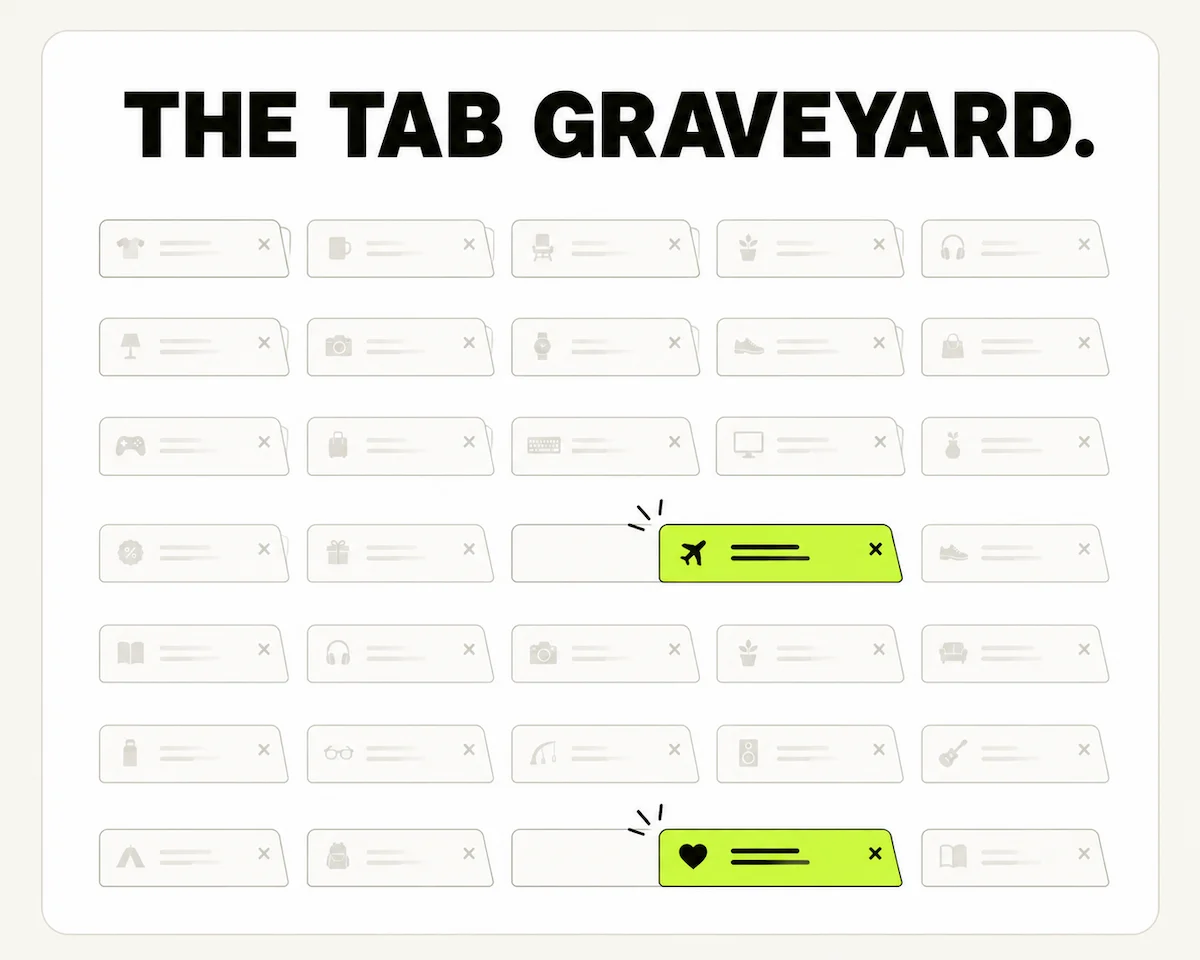
Most of the row has gone dim — you’ve stopped seeing it. The one or two still lit up are the ones quietly nagging at you.
Products in the graveyard don’t stop existing just because you stopped looking. Prices change. Sales end. Stock runs out. You might buy that jacket three months later at full price, never knowing it was 40% off the week after you first found it — and because you never noticed, you’ll never know what it actually cost you to look away.
Screenshots and bookmarks aren’t a fix
“But I save things,” you might say — into a camera roll where screenshots get buried between recipes and memes, or a bookmarks folder that’s really just a second graveyard with a different name and none of the shame of an open tab. These are general-purpose tools bent into a job they were never built for. (Here’s a system that’s actually built for it.)
What this actually costs
Say 10 products are lingering in tabs or screenshots at any given moment, and 30 of them turn into real purchases over a year. Pay even a modest 15% more than necessary on those — a missed sale here, an impulse buy there — and a $100 average purchase leaks $15 each. Thirty purchases, $450 a year, gone to nothing more sophisticated than not looking.
(Illustrative model — round assumptions, not a survey result. Real numbers vary; the mechanism is what holds.)
That’s the conservative version. It skips the late returns, the accidental duplicate you forgot you already owned, and every hour spent re-researching something you’d already researched once — the invisible costs that never show up on a single receipt, only on the total at the end of the year.
Breaking the cycle
The fix isn’t more discipline about tabs. It’s not using tabs for shopping at all.
What works is one place that captures a product in a single action, keeps it visible instead of buried, tracks its price without you asking, and lets you close the loop — buy it, archive it, delete it — so your brain can actually let go.
Do that and something shifts. You stop carrying twenty micro-decisions around all day and start making real ones, with real information, when you’re actually ready. You wait for genuine deals instead of buying to quiet the noise. You remember to return the thing that didn’t work out, because it’s not sitting forgotten in tab 34.
The tabs were never the real problem. Using them for a job they were never built for was.
Close them. Save what matters to one place. Let something else remember it for you — your attention was never supposed to be the filing system.