



Key takeaways
Retail prices follow a predictable yearly rhythm, but the calendar only gets you close — what you've actually watched on a specific item gets you exact.
- November does the most work overall, but almost every category has its own quieter low point somewhere else in the year — check the category before assuming you have to wait for Black Friday.
- A "was $X" discount is only real if the price was ever actually $X. Compare today's price to what you've actually observed, not the store's crossed-out number.
- Need it inside two weeks? Buy it. Otherwise, check whether this is actually a good month for that category before paying full price.
Buy a winter coat in October and you’re paying full price. Buy the same coat in January and US News Money says to expect up to 50% off winter apparel — same coat, same store, four months of patience is the entire difference.
Retailers run this calendar on purpose, every year. Sales aren’t random: inventory has to move, competitors match each other, and the promotional calendar gets printed months in advance, long before you ever see a banner.
Learn the rhythm and you’ll save real money. But a seasonal calendar only gets you close. What you’ve actually watched on the one thing you want gets you exact — the difference between “November is usually good for electronics” and “this laptop just hit $80 below anything I’ve seen it at.”
The monthly calendar
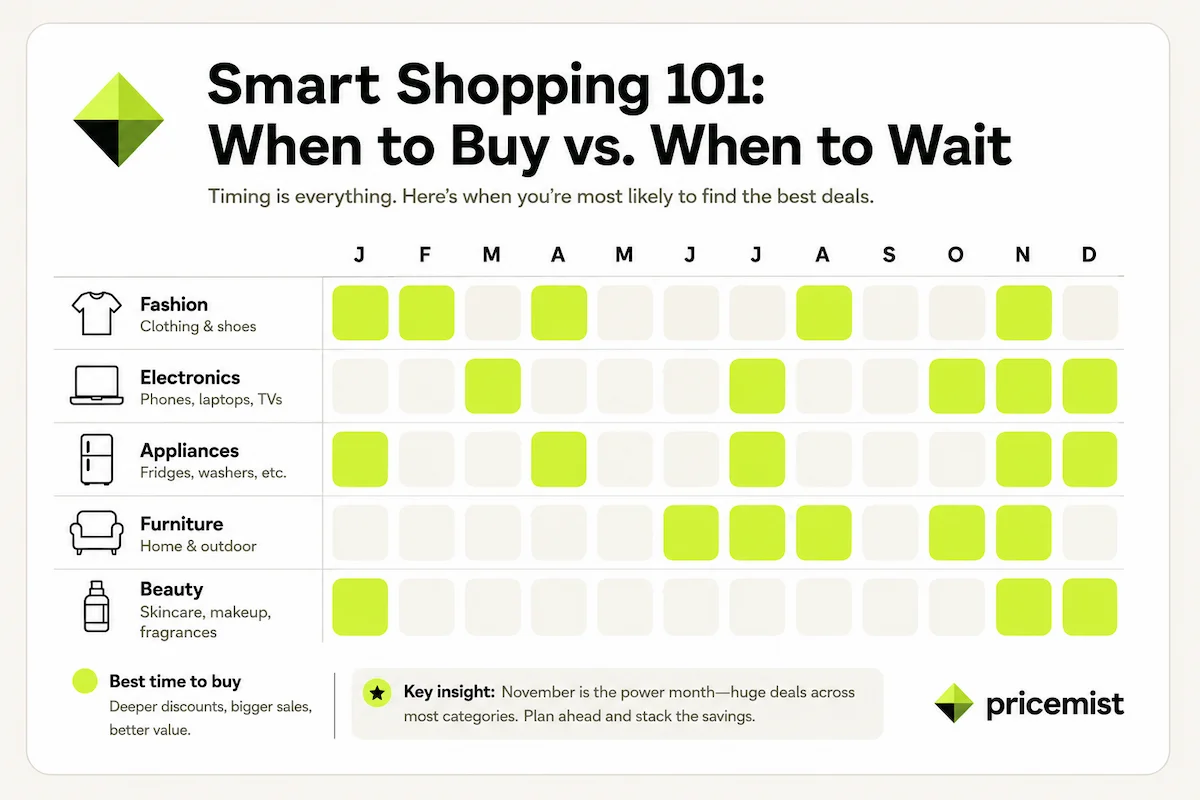
November does the most work across categories — but every category has its own quieter moments too.
January–February. Post-holiday clearance runs 40-70% off winter clothes, boots, and bedding — stores need the shelf space for spring. TVs drop hardest around the Super Bowl, mattresses around Presidents’ Day, both landing near their yearly low.
March–April. Luggage gets cheap right before spring break, when everyone’s booking travel at once. Winter stock takes its final markdown, and spring and garden items follow as retailers reset for the season.
May–June. Memorial Day is the real event for appliances and outdoor furniture. Tools and grills follow through Father’s Day and the Fourth of July.
July–August. Amazon Prime Day pulls electronics prices down across competing retailers too, not just Amazon. Summer clothing hits mid-season markdowns, then drops to 60-70% off by late August as fall inventory arrives — the same weeks back-to-school laptops go on sale.
September. Labor Day makes this the second-best month for mattresses all year, and the last real window on summer gear before it disappears from shelves.
October. The quiet month. Retailers are testing prices ahead of the holidays, which means this is patience season, not shopping season — November is only weeks away.
November. Black Friday and Cyber Monday: the actual event, and the best month for electronics and general goods across the board. It’s also exactly when retailers lean hardest on inflated “was $X” badges, which is why this is the month verifying matters most.
December. Buy gifts early, before selection thins out. Everything else waits for December 26th, when real post-holiday clearance starts.
Category timing
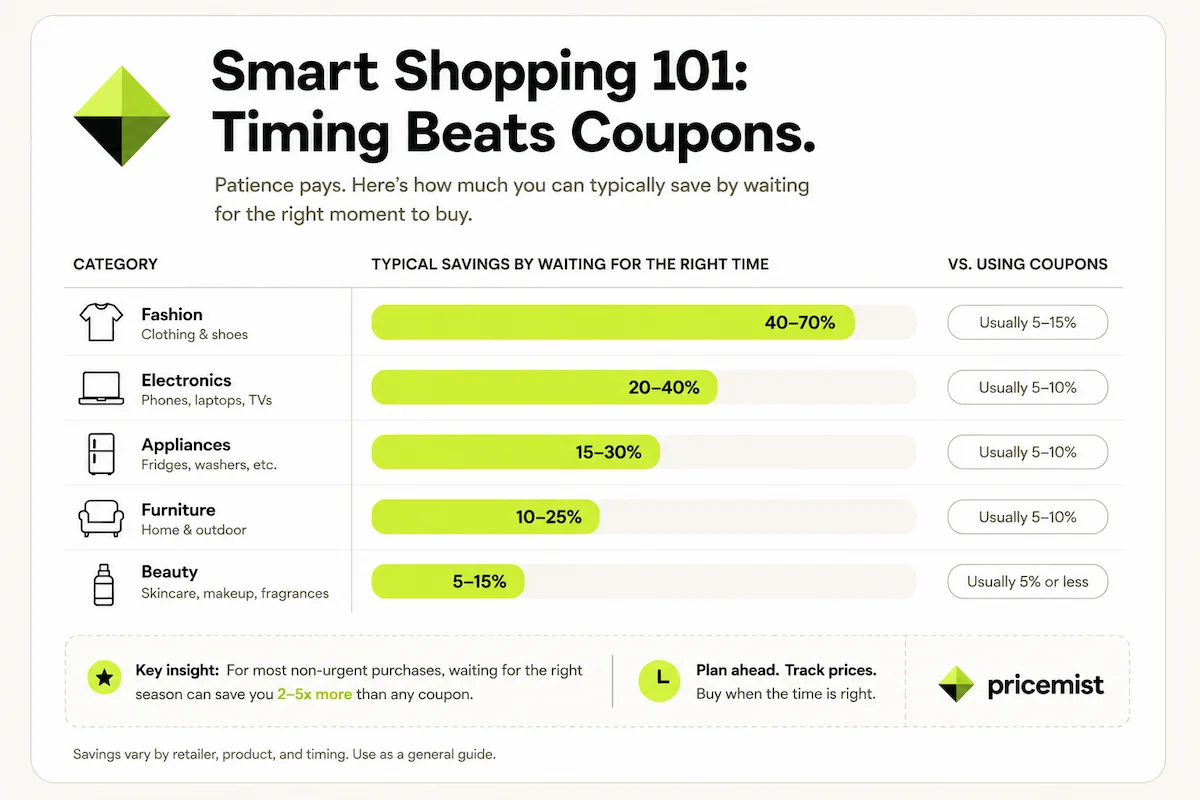
Fashion rewards patience the most. Beauty the least — but even a smaller sale window is still real money for waiting a few weeks. (Ranges in the chart and table below are typical clearance bands, not a single measured study.)
Some categories move on their own rhythm, separate from the general calendar above — worth knowing before you assume November is the answer for everything. For month-by-month deal windows, Consumer Reports’ best-time-to-buy guide is a solid cross-check.
| Category | Buy | Avoid | Typical clearance range |
|---|---|---|---|
| Fashion | End of season — January, July/August | New collection drops (Sept, March) | 40-70% |
| Electronics | Black Friday, right after new models launch | Right after a launch, or the holiday push before Black Friday | 15-30% |
| Appliances | Memorial Day, Labor Day, Black Friday | Random mid-month purchases | 20-40% |
| Furniture | January, July, holiday weekends | The moment you decide you “need it now” | 30-50% |
| Beauty | Sephora/Ulta sales (spring, fall), Black Friday | Regular price, any other time | 15-25% |
(Clearance ranges above are illustrative industry norms — timing columns are the claim worth verifying against CR or your own price history.)
Fashion moves the most because trends expire. Everything else moves mostly because of a calendar date.
Need it, or want it?
If the cost of waiting is real, buy now. Your coat broke in December, or you’re leaving for a trip next week with no suitcase — that’s need, and full price is completely fine.
If you’d just like it, ask one more question: is this actually a good month for this category? Buying summer clothes in June or a TV in September means paying peak price for something that’s reliably 30-40% cheaper in a matter of weeks.
Rough rule: if you don’t need it inside two weeks, and the calendar above says this isn’t the moment for that category, save it and wait instead of buying the first version of it you happen to see. Most impulse buys fail the first test. Most full-price buys fail the second.
The tricks retailers use
The perpetual sale. Some stores are “always 40% off.” That’s not a discount — it’s the real price, standing next to an inflated one for contrast.
A sale that never ends isn’t a sale. It’s just the price.
The fake markdown. “Was $150, now $99” only means something if it was ever genuinely $150. Without a price history behind it, you’re trusting the store’s arithmetic about its own product — and stores are not neutral about their own math.
The urgency push. “Ends tonight.” “Only 3 left.” Sometimes true. Often manufactured for exactly this reaction — a countdown works better on people than a price does. Either way, urgency is built to short-circuit the patience that actually saves you money.
The holiday hijack. Some retailers quietly raise prices in October specifically so November’s “discount” lands back at a completely normal number.
How to check it’s real
Retailers count on you not checking. Here’s how to check anyway:
- Start watching before the sale hits. Eyeing something for Black Friday? Start watching it in October. Now you know the real baseline price, not the number the store wants you to compare against.
- Check the historical low, not the listed discount. If today’s “sale” price is higher than a price you’ve already seen for that item, it’s not a deal — it’s marketing with a percentage sign on it. (Here’s how to read a price history chart.)
- Cross-check other retailers before you buy. An “exclusive” discount is frequently just everyone else’s regular price, dressed up for one store’s email list.
- Be suspicious of big percentages. “70% off” can still be a worse price than a smaller discount off an honest number — the percentage is only as real as what it’s counted from.
The whole point
You’re not buying different things by waiting — you’re buying the same things at a better moment. That moment shows up on a price chart weeks before it shows up in a marketing email subject line. Buy what you want. Just buy it at the right time.
The calendar above gets you close. What you’ve actually watched on the one thing you want gets you exact. If the last “sale” had you second-guessing, 5 signs you’re paying full price is worth a read. Or skip the guessing entirely and start watching a few things yourself.