



Key takeaways
Amazon-only price trackers cover a fraction of where people actually shop — fashion, beauty, and home goods mostly live outside them entirely.
- Amazon-only tools cover maybe a third of U.S. e-commerce GMV, leaving fashion, beauty, and home goods on other sites unwatched.
- Store wishlists don't fix this: they show today's price, not history, and they're built to get you to buy, not to help you wait.
- The mechanism that works anywhere is simple — paste a URL, something reads the price, and checks back daily — no "is this store supported" gate required.
Try to track a product’s price anywhere outside Amazon, and you’ll notice something fast: almost nothing was built for it.
CamelCamelCamel is Amazon-only. Keepa is Amazon-only. Even Honey’s price history leans almost entirely Amazon. Fine, if that’s the only place you shop. If you’re looking at Sephora, Nike, or Best Buy, none of it helps — you’re back to guessing, the same way shoppers guessed before any of these tools existed.
The Amazon-only blind spot
It’s an understandable focus. Amazon is the biggest single retailer, with data structured cleanly enough to track at scale — building for one giant store beats building for thousands of smaller ones, each with its own layout, its own quirks, its own way of hiding a price.
But that leaves a real gap. Fashion runs through Zara, H&M, ASOS, Nike, Adidas. Beauty runs through Sephora, Ulta, Glossier, The Ordinary. Home goods run through West Elm, IKEA, Wayfair, CB2. Electronics have Best Buy, Apple, and B&H Photo alongside Amazon, not instead of it. None of that is a niche — it’s most of what people actually spend money on.
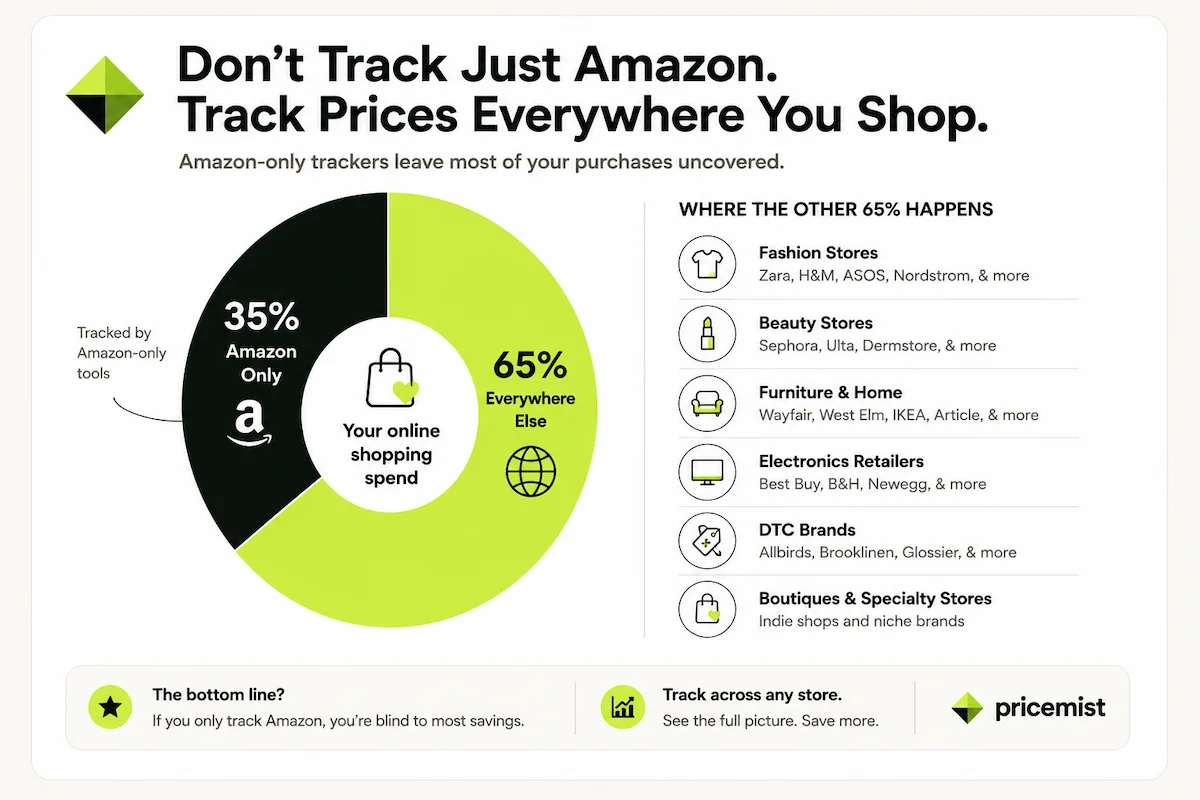
Round figures for the U.S. e-commerce market split — not any one shopper’s cart. Marketplace Pulse estimated Amazon at about 35.7% of U.S. e-commerce GMV in 2025.
Track only Amazon and you’re covering maybe a third of the U.S. online retail market — Marketplace Pulse put Amazon’s 2025 share around 35.7% of e-commerce GMV. Your own mix will differ, but fashion, beauty, and home goods still mostly live outside that slice — exactly where Amazon-only tools stop looking.
What that blind spot actually costs you
Without price history everywhere you shop, a few bad habits become the default — quietly, because none of them feel like a mistake in the moment.
You trust the sale tag at face value. No history means no way to tell a genuine 40%-off from a “sale” that’s quietly been the price for three months.
You buy out of anxiety, not certainty. Can’t save something and watch it? Then “what if it sells out” ends up making the decision for you.
You lose track across stores. The lamp at West Elm, the jacket at COS, the skincare at Sephora — three tabs, three mental buckets, no comparison possible between any of them, and no way to tell which one is actually the best use of the money.
You only catch real drops by luck. End-of-season markdowns, random Tuesday sales, inventory clearance — they happen constantly, and you see none of them without something actually watching. By the time a sale becomes visible enough to notice on its own, it’s usually already ending.
Store wishlists don’t fix this either
Every store has one. None of them help.
They’re fragmented — your Zara wishlist has never met your Sephora one, and checking ten different sites isn’t something anyone does consistently, no matter how good their intentions are on day one. They show current price, not history, so “$79 today” tells you nothing about whether that’s actually good or just the same number it’s always been. They exist to convert you, not to help you wait, which is why they’ll ping you about restocks and stay completely silent on price drops — a restock is a sale, a price drop is a cost. And when a store resets inventory for a new season, wishlist items quietly break — “no longer available,” with nothing to recover and no history to show for the months you spent watching.
What actually works: save anywhere, track everywhere
The mechanism is simple: paste a URL, something reads the page for name, image, and price, then checks back daily. No browser extension required, no “is this store supported” gate — if it’s a product page with a price, it can be tracked, whether that’s a major retailer, a fashion brand’s own site, or a boutique nobody’s heard of.
That gets you three things Amazon-only tools never could: everything in one view regardless of store, real price history instead of a retailer’s word for it, and alerts tied to the specific thing you’re watching instead of a generic marketing blast. Cross-device access matters here too — save something on your laptop at lunch, check it on your phone that evening, and it’s the same list either way. (What that history actually tells you, once you have it.)
Using it well
Found something? Paste the URL, done — it’s being watched. Ready to buy? Check it against the history: near the lowest you’ve seen, buy; not there yet, wait or set a target price and let it come to you. Once a week, skim what moved, drop what you’re no longer interested in, add what’s new — the same five-minute habit, regardless of how many different stores are involved.
Five minutes a week, and the payoff is usually a genuine 15-30% off things you were going to buy anyway, purely from knowing when “now” is actually a good moment instead of just a convenient one.
Moving beyond Amazon
Amazon-only trackers proved the idea: watching prices over time beats trusting a badge. But shopping outgrew the tool — direct-to-consumer brands, weekly fashion drops, boutique stores with inventory nobody else carries, none of which show up in a tracker that only ever learned to read one site.
Track whatever you actually buy, not just whatever’s easiest to track. Save anything. Watch everywhere. Buy at the right price, wherever it happens to be — Amazon included, just not Amazon only.