



Key takeaways
Impulse buying's real cost isn't the receipt — it's everything that never shows up on it.
- The real cost stacks up in opportunity cost, a full-price premium, a return that never happens, and a mental tax no bank statement tracks.
- The 48-hour test — wait before any unplanned purchase over $25 — cancels out most impulse urges through time, not willpower.
- Run the same year twice: an impulse shopper nets $4,250 spent; a mindful shopper making a similar number of purchases nets $1,665.
“I’ll just get this one thing.”
Famous last words. Consumer surveys put unplanned spending anywhere from $3,000-$3,400 a year on the lower end — Capital One Shopping’s research — up to $5,400 a year in an OnePoll survey of 2,000 Americans commissioned by Slickdeals. The exact number moves depending on who’s asking and when, but the pattern doesn’t: it adds up far faster than anyone budgets for.
And the real cost goes deeper than the number on the receipt — most of it never even shows up there.
Four costs that never show up on the receipt
The opportunity cost. Every dollar spent on impulse is a dollar that can’t go toward something you actually researched, saved for, or would have valued more. You’re not just spending money — you’re quietly choosing not to spend it on anything else, and that choice gets made without ever feeling like one.
The premium you pay. Impulse buying skips comparison shopping by definition: no waiting for a sale, no checking elsewhere, just whatever price happens to be on screen right now. Recognizing that pattern in the moment is most of the fix. (See 5 Signs You’re Paying Full Price.)
The return that never happens. In a survey of 1,000 US online shoppers by SimplicityDX, 56% regretted a recent impulse purchase — and 45% of those who regretted it kept the item anyway rather than dealing with a return. The item sits in a closet, tags still on, until the window closes and the money’s just gone.
The mental tax. Buyer’s remorse, clutter, financial anxiety, the low hum of managing things you shouldn’t have bought — none of it shows up on a bank statement, all of it is real, and it tends to outlast the excitement of the purchase by weeks.
Why the urge shows up in the first place
Dopamine fires on the anticipation, not the ownership. That’s why the thrill fades right after checkout — you were never chasing the product, you were chasing the moment right before you clicked buy. The product itself was almost beside the point.
Loss aversion does the rest. “Only 3 left.” “Sale ends tonight.” Missing a deal feels like losing something, so you buy to avoid the feeling, whether or not you actually need the item.
Social proof does the thinking for you. “Bestseller.” “Thousands of 5-star reviews.” Your brain takes the shortcut of trusting the crowd instead of evaluating for yourself.
Retail therapy works, briefly. Stressed, bored, sad — buying something is a real mood boost. It’s just a short one, and the expense outlasts the mood by months.
Friction removal does the quiet work underneath all of it. One-click ordering, saved cards, buy-now-pay-later — every convenience that shortens the gap between wanting and buying is a convenience built to skip the moment you’d normally reconsider. Less friction was never about saving you time; it was about saving you the chance to change your mind.
The 48-hour test
One rule cancels out most of this: wait 48 hours before any unplanned purchase over $25. See it, save it, come back in two days. Still want it, and can say why? Buy it.
In that gap, the dopamine fades, you forget the ones you didn’t really want, you stumble on a better price or a review that changes your mind, and life quietly reprioritizes for you. Most impulse urges don’t survive 48 hours — not because of willpower, because of time, and time is the one thing manufactured urgency is specifically designed to take away from you.
A system that does the work for you
Beyond the 48 hours: save instead of adding to cart — you haven’t said no, just not yet, and most saved items lose their shine on a second look. Unsubscribe from the marketing that manufactures urgency — you’re not missing deals, you’re removing triggers. Set a fixed “fun money” budget so occasional spontaneity is a decision you made in advance, not one a countdown timer made for you. Track the urge, not just the purchase — noting what triggered it surfaces patterns (bored, stressed, late at night) worth addressing at the root instead of one purchase at a time.
The math, side by side
Model two shoppers over a year, using round numbers:
| Impulse shopper | Mindful shopper | |
|---|---|---|
| Purchases/year | 100 unplanned @ $50 avg = $5,000 | 25 planned + 15 that passed the 48-hour test = $1,850 |
| Recovered via returns | 15% recovered = $750 | 10% recovered (and actually returned) = $185 |
| Net spending | $4,250 | $1,665 |
| Regret rate | 56% regretted the purchase | Under 10% |
(The regret rate above is the real, sourced figure from the SimplicityDX survey cited earlier — everything else in this table is an illustrative model, not a measured result.)
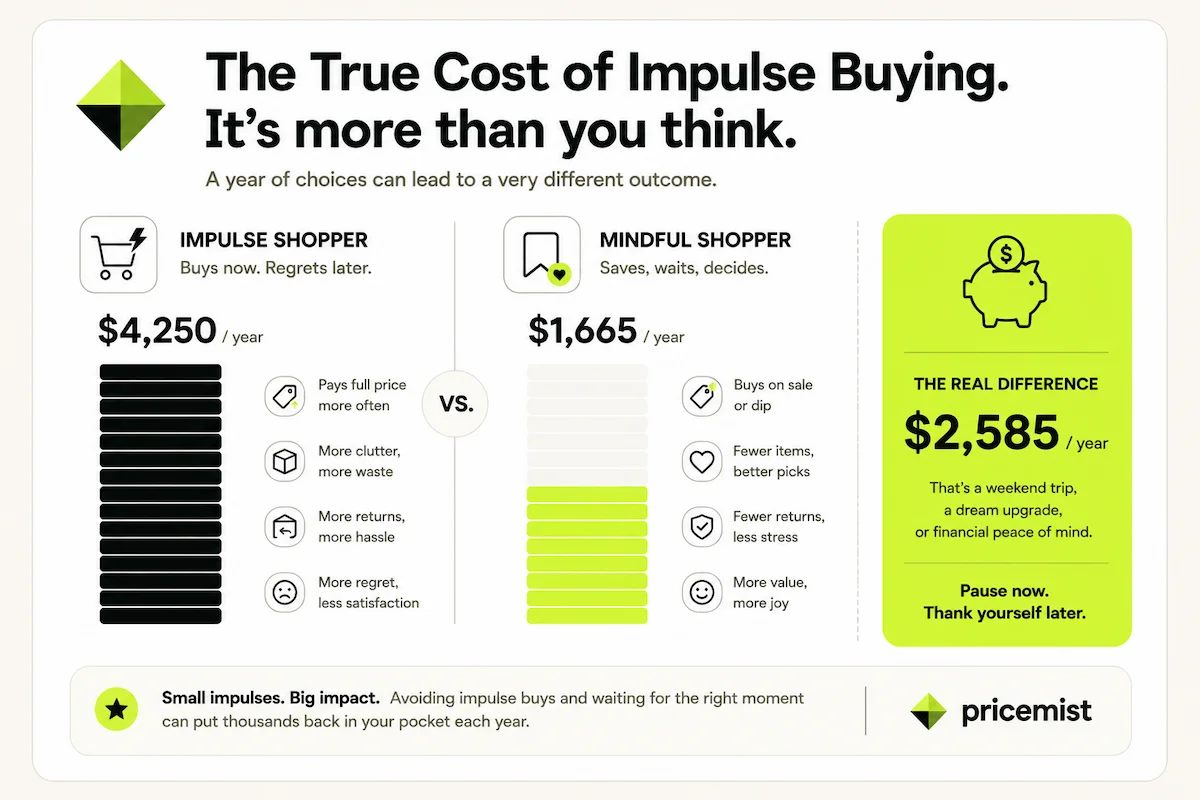
Same number of “I want this” moments both years. The only difference is what happens in the gap between wanting and buying.
The mindful shopper isn’t deprived — they’re buying the same category of things, just after actually deciding. Same wants, same number of tempting moments across the year, radically different bank balance at the end of it.
Breaking the cycle
Impulse buying doesn’t drain a bank account in one purchase. It’s the steady accumulation of a hundred small “just this once” moments a year.
None of the fix requires more willpower: wait 48 hours, save instead of buying on the spot, track what triggers the urge, and cut the marketing built to short-circuit all three. Buying less isn’t the goal — buying what you’d actually choose on a slower day is, and slower days are cheaper for reasons that have nothing to do with self-control.