



Key takeaways
Missed returns aren't a memory problem. They're a design problem — and the fix is visibility, not willpower.
- Missed returns happen because of no reminders, inconsistent windows across stores, and friction that lands exactly when you're busiest.
- On 50 typical purchases a year, missed windows alone run $75–200 — and one missed high-ticket return can beat that estimate by itself.
- Shipping the box back isn't the finish line. Track the return until the refund actually lands, not just until it leaves your hands.
Let’s talk about the pile.
You know the one — closet, spare room, back corner of the office. Tags still attached. Boxes never opened. Things you bought, didn’t love, meant to return, and didn’t.
Everyone has a version of this pile. Everyone underestimates exactly how much money is sitting in it — because unlike a single bad purchase, it never arrives as one number. It arrives as a sweater here, a gadget there, quietly, one missed deadline at a time.
The return window is a countdown you can’t see
Buy something online and a clock starts immediately. Most retailers give you 30 days. Some give 14. A few generous ones stretch to 60 or 90.
Countdown timers you can’t see are easy to ignore. The package arrives, it’s not quite right — wrong size, different color, not as nice in person — and you think “I’ll return this.” Then you don’t. Not today. The box moves from the doorway to the closet. Days become weeks.
By the time you remember, the window’s closed. That $80 sweater is yours forever now. Or rather, it’s the retailer’s $80, forever — you’re just storing it for them.
Why deadlines slip
Missing a return deadline isn’t a character flaw. It’s a design problem, and it stacks four ways against you — each one small enough to shrug off in the moment, which is exactly why the pile keeps growing.
Retailers don’t remind you. You’ll get 47 emails about new arrivals and exactly zero saying “you have 3 days left to return that.” Every missed return is profit sitting quietly on their side of the ledger.
Every store plays by different rules. Some count from ship date, some from delivery. Some exclude sale items outright. Keeping a dozen different windows straight in your head isn’t a memory problem — it’s a math problem nobody would choose to do voluntarily.
Returning something takes effort at the worst possible time. Find the item, find the receipt, print a label, repackage it, get it to a drop-off point. Every step is small friction, and when you’re busy, friction wins.
“Maybe I’ll keep it” is the easiest lie you’ll tell yourself all month. It’s less effort than dealing with the return. So you delay, and delay, until the deadline makes the decision for you.
The math, and it isn’t small
Online purchases get returned at close to a 1-in-5 clip — NRF and Happy Returns’ 2025 Retail Returns Landscape puts it at 19.3% for online sales, 15.8% retail-wide. And a striking share of those intended returns never actually happen: in a survey of 300+ online shoppers by Loop Returns, almost 9 in 10 admitted they’d kept something they’d actually meant to send back.
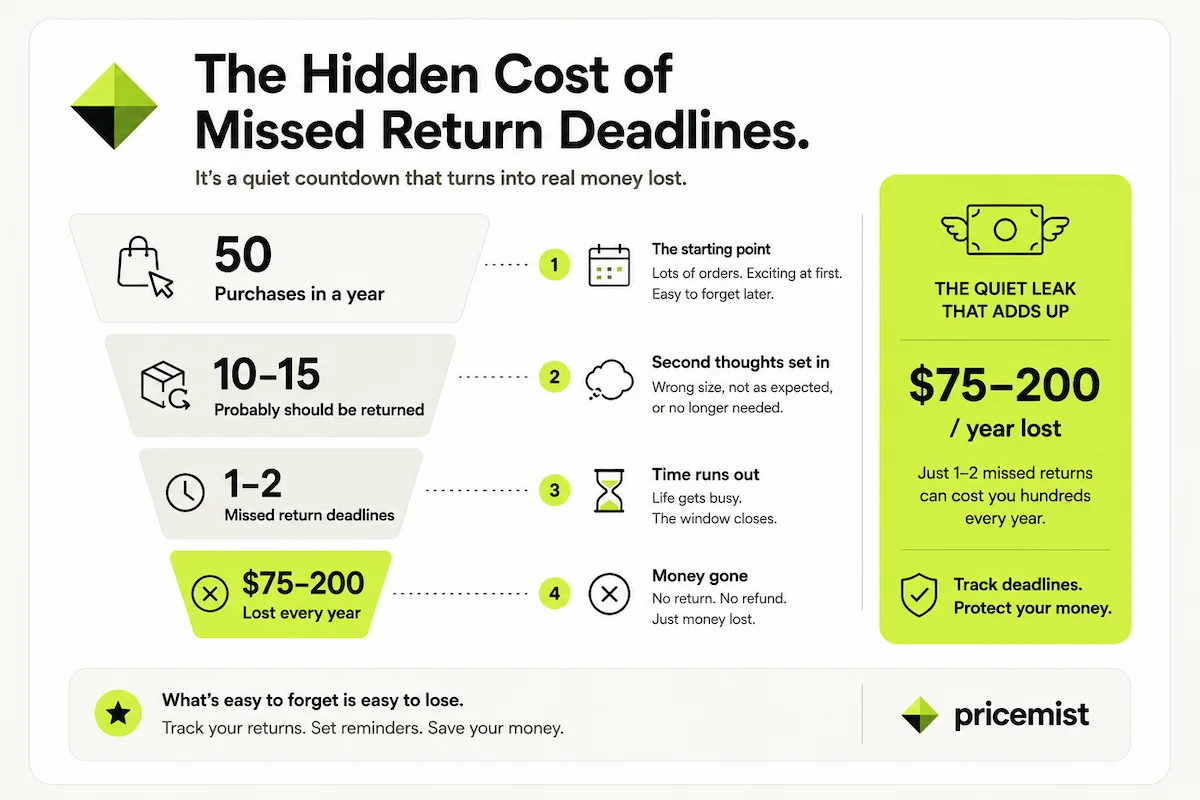
The leak is small at every individual step — which is exactly why it’s easy to ignore. It only looks big once a year, all at once. (Funnel bands are rounded for the graphic; the NRF rate below implies closer to ~10 return candidates out of 50.)
Run 50 online purchases a year at $75-100 each: at the NRF 19.3% online return rate, that’s about ~10 realistic return candidates. Miss even one or two of those to a closed window — easy to do, given how many people admit to it above — and that’s $75-200 a year gone to nothing. Shop more, or buy pricier things, and the number climbs fast — one missed $300 jacket return, one forgotten $150 gadget, and you’ve blown past that whole estimate with just two mistakes.
(NRF’s 19.3% is the sourced rate; the $75–200 total is an illustrative model — miss 1–2 of those ~10 candidates at $75–100 each — not a measured household average.)
None of this requires bad luck. It just requires the ordinary amount of “I’ll deal with it later,” applied to enough purchases over enough months.
Beyond the money, every item in the pile is an unfinished task your brain quietly keeps tabs on. Not loud, just persistent — the same low-grade nag that makes an open browser tab impossible to fully ignore. Eventually some people donate the item just to make the guilt stop, which is a fine outcome for the charity and an expensive way to feel better.
A system that actually holds
The fix isn’t “be better at remembering.” Nobody’s memory is built for tracking a dozen arbitrary deadlines across a dozen different stores — that’s not a discipline problem, it’s the wrong tool for the job.
What works is making the deadline visible instead of remembered:
- Log the purchase date the moment you buy — somewhere you’ll actually see it again, not just in your head.
- Note the return window right next to it. Look it up once; don’t gamble on remembering the number later. (Full cheat sheet for 40+ retailers here.)
- Set a decision deadline before the real one. A 30-day window with a 20-day decision point leaves 10 days of buffer to actually execute the return.
- Make “returning” a visible status, not a vague feeling. The moment you know, mark it. Ambiguity is what lets items linger.
- Track it until the refund actually lands. Shipping the box back isn’t the finish line — the money showing up in your account is.
Roughly ten minutes a week, against several hundred dollars a year. That’s the whole trade.
Stop donating to retailers
Missed return deadlines are one of the most common ways people lose money shopping — and one of the most fixable, because the fix has nothing to do with willpower.
Retailers won’t remind you. Your memory isn’t built for this. The only thing that works is a system that makes deadlines visible and returns frictionless enough that “later” doesn’t quietly become “never.”
Track the purchase. Watch the deadline. Get the money back. The pile doesn’t have to keep growing — and the version of you that finally clears it out isn’t more disciplined, just better informed.