

You needed something. You found it. You bought it. Simple, right?
Except most online shoppers overpay on a regular basis, and not because they’re careless. It’s because retailers are very good at making full price look like a deal: dynamic pricing, manufactured urgency, discount math that only works if nobody checks it. None of these tricks are hidden — they’re just designed to be looked at quickly and never twice.
You’ve felt the effects even if you’ve never named them: a closet with tags still on, a “deal” that turned out to be the regular price with a red banner slapped on top, a purchase you can’t quite remember deciding to make. None of that is bad luck. It’s five specific, fixable habits.
Here are five signs you’re the one not checking twice — and the one-line fix for each.
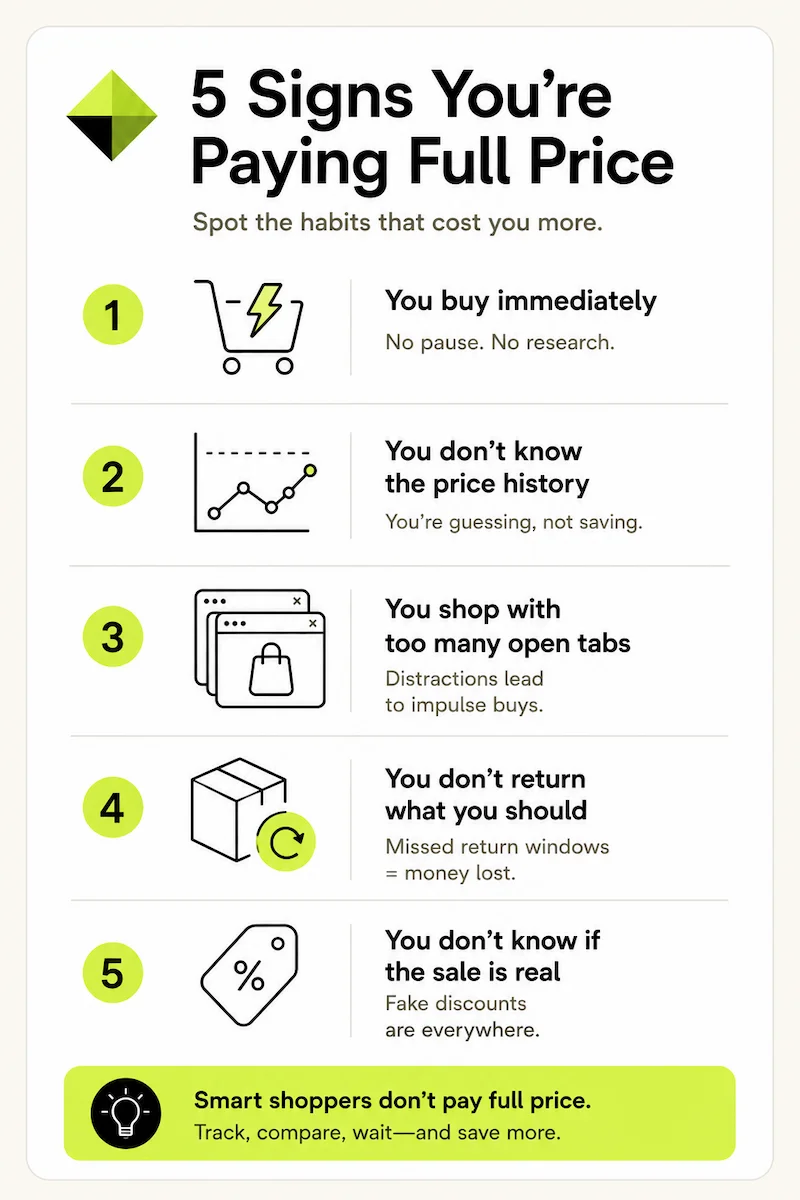
The quick version. Keep reading for the reality behind each one — and what to actually do about it.
1. You buy the second you find it
That flash of “I need this now” isn’t an accident. Retailers have optimized every pixel of checkout to trigger exactly that feeling, right before you’d normally stop and think it through.
The catch: prices move constantly. The $120 jacket you’re buying today was $85 last week, or will be $85 next week. Buying on the spot means buying at whatever number happened to be on screen the moment you clicked — not the number the item actually trades at most of the time.
The fix: save it, wait 48 hours, decide with a clear head. Watch the price instead of guessing at it, and you’ll notice how often “full price” turns out to be the exception, not the rule.
2. You don’t know the price history
“Was $150, now $99!” reads like a steal — until you find out the item has sat at $99 for six months and the $150 never actually happened to anyone who bought it.
The catch: without history behind it, you’re trusting the retailer’s arithmetic about its own product. That’s not a neutral source, and it never will be — the store writes the “was” price, the “now” price, and the percentage in between.
The fix: watch the actual price line, not the crossed-out number sitting next to it. Once you’ve seen something hit $79 twice, a “sale” at $99 stops feeling urgent and starts looking like the markup it is.
3. Your “maybe” pile lives in 23 browser tabs
Seven of them are “considering.” You’ve been considering them for three weeks. When you finally decide to buy, you can’t remember which window it was in — Chrome or Safari, laptop or phone — so you buy the first one you find, at whatever it costs today.
The catch: mental clutter produces rushed decisions, not careful ones. You lose track of prices, sales, and sometimes what you actually wanted in the first place, which is how the same jacket ends up bought twice.
The fix: one place for everything you’re watching, not six tabs across three windows and a screenshot folder. (Why scattered tabs cost you actual money.)
4. You’ve never returned something you should have
Be honest: how much is sitting in your closet right now with the tags still on, waiting for a version of you with more free time?
The catch: retailers count on return friction. Miss the window, forget it exists, decide it’s “not worth the hassle” — all three outcomes end the same way, and that way is free money for them. They will not send an email reminding you.
The fix: know the deadline before you need it. Seeing “Return by Dec 15” next to an item is the difference between acting on it and donating to a company that didn’t ask. (The real cost of missed windows.)
5. “On sale” stopped meaning anything a while ago
Flash sales, doorbusters, members-only pricing, early access, a countdown clock ticking on a page that’s said “ends tonight” for a month — when everything is always on sale, nothing is.
The catch: a 15%-off coupon still feels like a win even when the item was 25% cheaper two months ago and nobody told you. The percentage is real. The comparison it’s built on usually isn’t.
The fix: measure discounts against what you’ve actually seen an item cost, not the badge on the page. A real deal hits a new low. Everything else is just a sticker doing its job.
The pattern, not the purchase
Paying full price isn’t the problem. Paying it by accident is — not knowing the history, missing a deadline, getting swept up in a countdown that didn’t need to work on you. That’s money leaving your account for a reason you’d never actually sign off on if you saw it clearly, five separate times a year, quietly enough that it never feels like a pattern.
Save before you buy. Check the price before you trust the badge. Know the deadline before the box makes it to the closet. None of it takes more than a few seconds — it just has to happen before checkout, not after.
None of these five fixes require willpower. They require the information to already be sitting in front of you when you’re about to click “buy” — not buried in an email, not trusted to memory, just visible.
Start with the chart: Price History Charts Explained shows you exactly what to look for.